
NYT Strands Hint vs Answer: Get Help Without Spoilers
The difference between a Strands hint and a Strands answer is how much of the puzzle gets finished for you. A hint points you toward the solution — a theme direction, a nudge about the spangram, or the letters of one theme word — and leaves the rest of the board for you to solve. An answer hands you the completed puzzle: every theme word, the spangram, and the theme itself, with nothing left for you to find.
That gap matters because Strands is a puzzle you play with your hands. The satisfaction is in tracing the letters and recognizing the theme. The moment you read the full answer, the puzzle is over — even if you hadn't finished tracing a single word. So the Strands hint vs answer question is really about timing: how little help can I take and still finish? Here's what each kind of help reveals, how to climb a spoiler ladder one rung at a time, and when a full answer is the right call.
Strands Today is an independent fan site. We are not affiliated with the New York Times. To play the official puzzle, visit nytimes.com/games/strands — then come back for spoiler-light hints when you get stuck.
What's the difference between a Strands hint and a Strands answer?
A Strands hint is any nudge that moves you forward without finishing the puzzle. It can be as small as a one-line theme direction ("think about classic literature") or as specific as the first two letters of a theme word. After the hint, you still have to trace the words yourself — the hint narrows the search, it doesn't replace it.
A Strands answer is the completed board. It names the theme, lists every theme word, shows the spangram, and often shows where each word sits on the grid. After reading the answer, there is no puzzle left to solve.
Here's the practical spectrum, from least revealing to most:
| Level | What you learn | What's left for you |
|---|---|---|
| Theme direction | The category of the theme, vaguely | All words and the spangram |
| Spangram nudge | A description of the spangram, not spelled out | All theme words, and you still trace the spangram |
| Theme word letters | Letters of one theme word light up | The rest of the theme words |
| Full answer | Every word and the spangram, spelled out | Nothing |
The first three rows are hints. The last row is the answer. Most daily-solver blogs skip straight to the last row — great if you only care about your streak, terrible if you wanted to enjoy the puzzle.
What does a Strands hint reveal?
A good hint reveals the smallest thing that unblocks you. The in-game hint system built into Strands reveals the letters of one theme word, one at a time, and you can stop the moment you recognize the word. (We explain the full mechanic — finding three non-theme words to earn a hint — in How Do Hints Work in NYT Strands?.) That's a medium-spoiler hint: it gives you a word, but not the theme, and not the spangram.
External hint pages can be gentler. The smallest useful hint is a theme direction — a short phrase that points at the corner of the theme's meaning without naming anything on the board. If today's clue is "On this day in 1963," a theme direction might be "think about American history and a famous speech." That alone can restart a stalled solve, because now you know what family of words to hunt — and you still get the satisfaction of finding every word yourself.
The key test for any hint is: after I read this, is there still a puzzle to solve? If yes, it's a hint. If no, it's an answer dressed up as a hint.
What does a Strands answer page show?
A full Strands answer page shows the completed board: the theme, every theme word, and the spangram, usually with the grid positions marked so you can see where each word sits. Mashable, CNET, Lifehacker, and similar daily-answer sites publish this every day, typically within hours of the puzzle going live. These pages are useful if you've already given up, but they offer no place to stop — the moment you scroll past the warning, the puzzle is over.
Here's what a completed board looks like — the August 28, 2026 Strands puzzle with the theme clue "On this day in 1963" and the yellow spangram IHAVEADREAM spanning the grid:
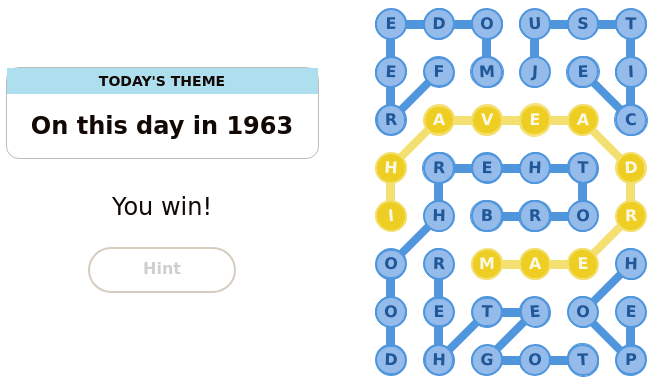
Notice what seeing this board does: the theme is immediately obvious, every word is visible, and there is nothing left to trace. If you had been mid-solve and saw this image, the puzzle would be over for you whether you'd finished it or not. That's the cost of an answer page.
How do you get help without spoiling Strands?
The trick is to climb a ladder, not jump to the top. A staged hint page lets you take one rung at a time and stop the moment the puzzle clicks. Here's the sequence, shown on the August 28 puzzle:
- Reread the theme clue before asking for anything. "On this day in 1963" — what happened on that date? A famous speech? A landmark event? Often the clue alone restarts a stalled solve.
- Take the theme-direction rung. A good first step tells you which corner of the theme's meaning to think about — American history, civil rights, a famous speech — without naming anything on the board.
- Ask for a spangram nudge, not the spangram. The next rung describes the spangram without spelling it: the theme's label is the title of the most famous speech from that era. If you know your history, you now have
IHAVEADREAMin your head — and you still get to trace it yourself. - Reveal letters only if you're still stuck. The final rung shows the spangram or theme words letter by letter, and you can stop the instant you recognize one.
- Read the full board only if you're done trying. The completed puzzle is always at the bottom of the page — there if you want it, but never forced on you.
Our daily Strands hints page is built exactly this way. Each rung sits behind its own button, so you can take the theme direction, decide it's enough, and finish on your own.
When should you take a hint vs read the full answer?
There's no moral high ground — the right choice depends on what you want out of today's puzzle. A rough guide:
- Take a hint when you're stuck but still want to solve. A theme-direction hint costs almost nothing and leaves every word for you to find.
- Take a spangram nudge when you've found some words but the theme won't come. The spangram names the theme, so once you have it, everything else falls into place.
- Read the full answer when you've given up. Out of time, out of patience, or the theme is in a category you don't know (a sports theme when you don't follow sports) — the answer is there. The only cost is that day's puzzle is over.
- Read the full answer when you've already solved it. If you finished the board and want to verify, the answer page is a check, not a spoiler.
The one situation to avoid is the accidental answer — scrolling past a "spoilers ahead" warning, or opening a thread where someone posted the full board in the first reply.
Does reading the answer ruin the Strands experience?
It doesn't ruin the game — Strands puts out a new puzzle every day, so there's always tomorrow. But it does ruin that day's puzzle. The whole point of a word puzzle is the moment of recognition: you stare at a chain of letters, it doesn't mean anything, and then suddenly it does. Reading the answer skips that moment.
There's also a stats angle. Strands tracks whether you solved each puzzle "without hints." Reading an external answer page doesn't touch that stat — the game has no way to know you peeked — but it does mean you didn't really solve the puzzle. If you care about the "without hints" flag, you probably also care about not reading the answer, for the same reason: both say "I did this myself."
If you're running out of time before midnight, a staged hint is almost always the better trade. It keeps the puzzle alive, finishes the board, and only touches the "without hints" flag — far less painful than breaking the streak.
What is a staged Strands hint ladder?
A staged hint ladder is a format for publishing the day's help from least to most revealing, where each step sits behind its own button. The reader chooses how far to climb, so they never see more than they wanted to. A typical ladder has five rungs: theme direction, theme clarification, spangram nudge, spangram and theme word letters, and the full board. The difference between a ladder and a one-screen answer page is that the ladder gives you a place to stop at every step.
Our Strands archive uses the same ladder format for every past puzzle. Each date page — like the August 24, 2026 puzzle — gives you the rungs in order, so even when you're catching up on an old puzzle, you can solve it yourself with the same spoiler control as the daily game.
FAQ
What's the difference between a Strands hint and a Strands answer?
A hint nudges you toward the solution without finishing the puzzle — a theme direction, a spangram nudge, or the letters of one word. An answer hands you the completed board: every theme word and the spangram, fully spelled out.
Does using a Strands hint reveal the answer?
Not usually. The in-game hint reveals the letters of one theme word, but not the theme, the spangram, or the other words. A staged hint page can reveal as little as a one-line theme direction.
When should you read the full Strands answer?
Read the full answer when you've given up, when you're out of time before midnight and need to protect your streak, or when you've already solved the puzzle and want to verify.
Do daily-answer blogs spoil the Strands puzzle?
Yes, by design. Blogs that publish the full board every day give you no place to stop — the moment you scroll past the warning, the puzzle is over. A staged hint page gives you a place to stop at every step.
Does reading the answer affect your Strands stats?
No. Strands only tracks hints used inside the game. Reading an external answer page doesn't touch your "solved without hints" flag — but it does mean you didn't really solve that day's puzzle yourself.
Get help with today's Strands without spoiling it
If you're stuck on today's puzzle, climb the ladder instead of jumping to the end. Start with our spoiler-light Strands hints page: take the theme-direction rung first, then a spangram nudge, and stop the moment the puzzle clicks. If you want to see how staged hints work on a past board, browse the Strands archive — and when you're ready for the next puzzle, today's hints are waiting on the homepage.
Need a nudge for today's puzzle?
Get spoiler-light hints for the current NYT Strands puzzle.
Today's Hints