
What Is a Spangram in NYT Strands?
A spangram is the special theme word in every NYT Strands puzzle that stretches from one side of the letter grid to the opposite side — and names the puzzle's theme. Unlike the other theme words, which are examples of the theme, the spangram defines it. When you find it, the board highlights it in yellow, and the rest of the puzzle usually falls into place.
Every Strands puzzle hides exactly one spangram among its 48 letters, and you need it to finish the board. If you are new to Strands, understanding the spangram is the single biggest jump in solving ability — bigger than any hint. Below is how it works, how to spot one, and the mistakes that keep solvers from finding it.
Strands Today is an independent fan site. We are not affiliated with the New York Times. To play the official puzzle, visit nytimes.com/games/strands — then come back for spoiler-light hints when you get stuck.
What is a spangram in NYT Strands?
In NYT Strands, the spangram is a single word that connects two opposite sides of the 6×8 grid, touching one edge before reaching the other. Per the official NYT Strands rules (last verified August 2026), it is the word that "describes the puzzle's theme" — while every other theme word is merely an example of that theme.
A simple way to tell them apart:
- Theme words are members of the theme. If the theme is a type of food, they are foods.
- The spangram is the label for the theme itself. It is often a compound word or a category name — the umbrella the other words stand under.
Because the spangram has to physically reach across the board, it is usually the longest word in the puzzle, and it uses more letters than any other single answer.
How does the spangram look on the board?
Before you find anything, the Strands board gives no visual clues — just 48 letters in a 6×8 grid and a theme clue at the top. The colors only appear as you solve:
- Theme words light up blue when you trace and submit them.
- The spangram lights up yellow and stretches across the board from one side to the other.
The spangram's path bends. It does not run in a straight line like a word-search word — it snakes through adjacent letters, turning as needed, the same way theme words do. The difference is where it starts and ends: on opposite edges of the grid, most often the left and right sides.
Every letter in the grid is used exactly once by the theme words and the spangram combined. That "48-letter rule" is also a useful check: if your guessed word overlaps letters you have already used, it cannot be correct.
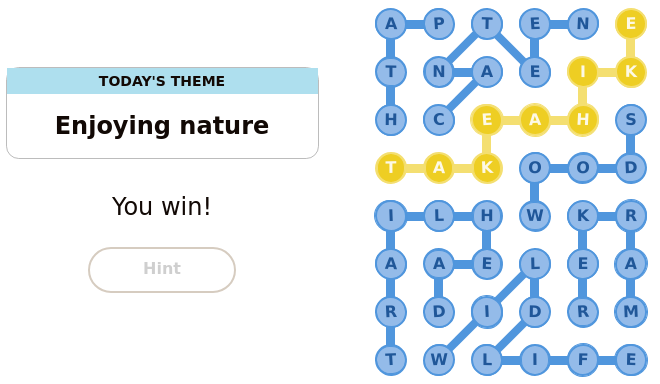
Here is a real board from the August 25, 2026 puzzle — theme words lit up in blue, and the spangram TAKEAHIKE stretched across the grid in yellow:
Why is the spangram the key to solving Strands?
The spangram is worth finding early because it converts a vague theme into a concrete category.
Consider how a typical solve goes wrong: you read a theme clue like "Feel the beat," see 48 letters, and have no idea where to start. Theme clues are deliberately broad — they point at a category without naming it. But the spangram is the category. Once "DRUMSOLO" or "TEMPO" spans the board in yellow, the remaining words are no longer "anything related to music" — they are specific members of a family you can now name.
That is also why finding the spangram feels like the puzzle's turning point. It cuts the search space from "every word hidden in 48 letters" to "words that fit this exact category," which is a much shorter list.
How do you find the spangram in NYT Strands?
There is no guaranteed formula — the spangram is found, not given — but experienced solvers use the same few habits:
- Read the theme clue first, and guess the label. Before touching the grid, ask: "If this theme were one word or a compound, what would it be?" Your guess becomes a target.
- Start from an edge. The spangram touches opposite sides, so at least one end of it sits on the border of the grid. Scan the outer columns and rows first.
- Hunt long, bendy paths. A word that needs 8–12 letters must turn corners. Trace a few steps from an edge letter and see whether a real word starts to form.
- Test compound words. Spangrams are frequently compounds — two words fused into one, with no space. If the theme is about breakfast, think "SUNNYSIDEUP" style constructions rather than short words.
- Bank theme words as scouts. Every three non-theme words you find earns an in-game hint, and theme words you do find often share letters with the spangram's path. Solving and scanning feed each other.
If you want a nudge without the full answer, our spoiler-light Strands hints page reveals the spangram in stages — theme direction first, then its length and position, and only then the word itself. You control each step.
To see the process in action, look at how a real solve unfolds. On that same August 25 board, the theme clue read "Enjoying nature" — a classic broad category that could point almost anywhere. The first move is guessing the label: OUTDOORS? NATUREWALK? HIKING? Each guess becomes a target you test against the edge letters. The actual spangram, TAKEAHIKE, is exactly the kind of answer the habit is built to find — a two-word compound fused into one unbroken word, starting on one edge and ending on the other. And once it landed in yellow, the rest of the board stopped being "anything nature-related" and became a tight family of outdoor-walk words that almost named themselves. That is the whole habit, repeated until something clicks.
What are the most common spangram mistakes?
- Assuming it runs in a straight line. New solvers scan rows and columns like a classic word search. The spangram changes direction — follow adjacent letters, not fixed lines.
- Looking for short words. Short words are almost never the spangram. Something has to physically bridge the board, so think long.
- Expecting a space between words. The spangram is submitted as one continuous word. Compounds like "BUTTERFLY" appear fused, not as two separate entries.
- Ignoring the theme clue's part of speech. If the clue hints at an activity, the spangram is often a gerund or an "-ing" compound; if it hints at a collection, expect a plural-style label.
- Spending all your guesses on the spangram. Random tracing burns time. If nothing forms after a few attempts, switch to finding theme words — they sharpen your picture of the theme and earn hints.
Can the spangram be two words?
No — the spangram is always traced and submitted as a single, unbroken word. It can look like two words glued together (compound spangrams are common), but there is no space and no break in the chain of letters. If you find yourself trying to submit two separate words as the spangram, one of them is probably just a regular theme word.
How does the spangram change your hint strategy?
Knowing what the spangram does changes when you should ask for help. In Strands, you earn an in-game hint by finding three words that are not part of the theme — a deliberate design that rewards exploration instead of punishment. A hint then reveals letters of a theme word, one step at a time.
Solvers who chase the spangram early tend to use fewer hints overall, because a found spangram narrows the remaining answers so sharply that the theme words almost suggest themselves. The reverse is also true: if you burn hints on individual theme words while ignoring the spangram, you may finish the board having never understood the theme at all.
Many players also care about their stats — Strands tracks whether you solved a puzzle "without hints," and a spangram-first approach is the most reliable way to protect that streak of clean solves. If you want to study the habit on past boards, the Strands archive lets you review how previous spangrams sat on the grid.
FAQ
Does every NYT Strands puzzle have a spangram?
Yes. Every daily Strands puzzle contains exactly one spangram, and the board is not complete until you find it along with all the theme words.
What color is the spangram in Strands?
Yellow. Regular theme words highlight in blue when found, while the spangram highlights in yellow and spans from one side of the grid to the opposite side.
Do you have to find the spangram to finish the puzzle?
Yes. The spangram is one of the required words on the board — it is not optional bonus content. Most solvers try to find it early because it reveals the theme.
Is the spangram always the longest word in the puzzle?
Usually, but not always by strict letter count. Because it must connect opposite sides of the grid, it is almost always among the longest — but a long theme word can occasionally rival it.
Does finding the spangram use up a hint?
No. In-game hints are earned by finding three non-theme words, and nothing about the spangram costs a hint. It is found by tracing letters, just like any theme word.
What should you do after learning the spangram rules?
Reading about spangrams is the easy part — spotting one in today's grid is where it gets fun. Our daily Strands hints page layers today's spangram reveal step by step — theme direction, letter count, board position, then the full word — so you can stop at exactly the level of help you need. After that, browse the Strands archive to see how past puzzles' spangrams behaved, or head to the homepage for today's hints.
Need a nudge for today's puzzle?
Get spoiler-light hints for the current NYT Strands puzzle.
Today's Hints