
How to Play NYT Strands (Beginner's Guide)
To play NYT Strands, find all the words hidden in a 6-by-8 grid of 48 letters that share a common theme — plus one special word, the spangram, that spans the board from one side to the other and names the theme. You trace words by connecting adjacent letters in any direction, every letter on the board is used exactly once, and there's no penalty for wrong guesses. Stuck? Finding three ordinary words that aren't part of the theme earns you a hint.
That's the whole game in one paragraph — but the details are what turn a frustrating first week into a daily habit. This guide covers everything a new solver needs: how the grid works, how to trace words, what the spangram does, how hints and stats behave, and a complete walkthrough of a real puzzle. By the end, you'll know exactly how to approach today's board.
Strands Today is an independent fan site. We are not affiliated with the New York Times. To play the official puzzle, visit nytimes.com/games/strands — then come back for spoiler-light hints when you get stuck.
What is NYT Strands?
Strands is the New York Times' daily word-search puzzle — launched from beta into the NYT Games lineup in 2024 — and it's a word search only in the way chess is a board game. The surface similarity ends quickly:
- In a classic word search, you're given a list of words to find in straight lines.
- In Strands, you're given only a theme clue — a short, deliberately vague hint like "You can't eat just one" — and have to work out both the words and the category they belong to.
Every puzzle has one new board per day, free to play, that resets at local midnight (more on that below). It sits alongside Wordle and Connections in the NYT Games app and on nytimes.com/games, and like those games it has become a shared daily ritual: one board, millions of solvers, no spoilers until you've finished.
If you're arriving from Wordle or Connections, the adjustment is mostly mental. Strands asks for vocabulary breadth (what words could hide in these letters?) and pattern-reading (what does this clue really point at?) rather than a single deduction.
How does the Strands board work?
Every Strands puzzle is built the same way:
- A 6-by-8 grid holding 48 letters. No blanks, no wildcards — every tile is a letter.
- A theme clue at the top. One short phrase. It's a riddle, not a label: it points at the theme without naming it.
- A set of theme words hidden in the grid — usually five to eight words that are all members of one category.
- Exactly one spangram — the word that names the category itself, stretching from one side of the board to the opposite side.
The rule that makes the board feel tight: every letter is used exactly once, by the theme words and the spangram combined. Nothing is wasted, and nothing overlaps. That "48-letter rule" is also your error checker — if a word you're tracing runs through letters that a found word already claimed, it can't be right.
When you submit a correct theme word, its letters light up blue. When you find the spangram, it lights up yellow and visibly bridges the board. Watching the grid fill with color is the game's quiet reward loop.
One more detail that trips up new players: the grid starts completely dark and unmarked. There are no hints baked into the board itself — no shaded cells, no bold letters, nothing distinguishing a tile that's part of the spangram from a tile that isn't. The only information you get before your first find is the theme clue and 48 letters. Everything else, you earn.
How do you trace words in Strands?
Submitting a word is a matter of dragging across letters — click or tap the first letter and drag through the rest, or tap each letter in sequence. The physical rules:
- Letters must be adjacent. Each next letter touches the previous one — horizontally, vertically, or diagonally.
- The path can bend. Unlike a classic word search, words change direction mid-word. A theme word might start going right, turn down, then cut diagonally. Long words always bend.
- No letter is reused within a word. One tile, one use per submission.
- Release to submit. If the chain is a valid word, one of two things happens: it's a theme word (blue highlight, progress) or it's a non-theme word (counted toward your next hint).
And the rule beginners are always relieved to hear: wrong guesses cost nothing. Trace a nonsense chain, release, nothing happens. No penalty, no streak damage, no shaming. Exploration isn't just allowed in Strands — it's the core skill, because it's how you earn hints.
What is the spangram and why does it matter?
The spangram is the single most important concept in Strands, and the biggest jump in solving ability for a new player. In short:
- It's a word that spans the grid from one side to the opposite side — most often left to right.
- It names the theme while the other words merely belong to it. If the theme words are MACAROON, SNAP, and SNICKERDOODLE, the spangram is COOKIEJAR.
- It's usually the longest word on the board, and it's often a compound of two words fused together with no space.
- You cannot finish the puzzle without it — it's a required word, not a bonus.
Why does it matter so much? Because finding the spangram converts a vague theme into a concrete category. A clue like "An epic journey" could point almost anywhere — but once THEODYSSEY spans the board in yellow, the remaining words are obviously characters and stops on Odysseus's trip home. One find collapses the search space.
The habit to build: before touching the grid, read the clue and guess what the theme's one-word label would be. Then scan the board's edges — the spangram must touch opposite sides, so at least one end sits on the border. We cover the full method (and the common mistakes) in What Is a Spangram in NYT Strands?.
How do hints work in Strands?
Strands has a built-in hint system that rewards exploration. The short version: find three valid words that are not part of the theme, and you earn one hint. Spending a hint reveals the letters of one unfound theme word, one letter at a time — you can stop the reveal the moment you recognize the word and trace it yourself.
Details worth knowing on day one:
- Non-theme words must be four letters or longer, and they can't be theme words you've already found.
- There's no limit on hints — every three non-theme words earns another.
- Hints never reveal the spangram, only theme words.
- Using a hint doesn't break your streak — it only removes that day's "solved without hints" mark from your stats.
Beyond the in-game button, there are staged hint pages (like this site's) that reveal information in steps — theme direction first, then a spangram nudge, then letters — so you never see more than you asked for. The full mechanics, stats impact, and a spoiler-ladder strategy are in How Do Hints Work in NYT Strands?.
How do Strands stats and streaks work?
Strands tracks three things about you, and only three: how many puzzles you've solved, your current streak of consecutive days solved, and whether each of those solves happened without hints. That's the entire scoreboard — no points, no rankings, no timer.
The streak is the one that shapes behavior. It counts consecutive days, so it resets if you miss a day — not if you use a hint, and not if a puzzle takes you an hour. This is why the local-midnight reset matters so much to regular players: solve before midnight in your time zone, and the streak survives; fall asleep on the couch, and it doesn't.
The "without hints" flag is the perfectionist's stat. Using a single in-game hint removes it for that day, while your streak and solve count keep going. If you care about clean solves, the spangram-first approach in the next section is your best protection — naming the theme early is what makes hints unnecessary.
How do you solve a Strands puzzle step by step?
Here's the complete method, demonstrated on a real board — the August 24, 2026 puzzle, theme clue: "You can't eat just one." (A past puzzle, so no spoilers for today.)
Step 1: Read the clue and brainstorm before touching the grid. "You can't eat just one" is a familiar advertising rhythm — it sounds like a snack slogan. What can't you stop at one of? Chips, cookies, candy? Make a mental list of candidate categories and candidate words before you start dragging. Two minutes of thinking saves ten minutes of random tracing.
Step 2: Guess the spangram's label. If the theme is one word or compound, what is it? For a snack category, maybe SNACKS, COOKIES — or, if the theme is about where they're kept, COOKIEJAR. Hold those guesses; you'll test them against the edges.
Step 3: Trace a few obvious letter chains. Look for promising fragments — long chains near the edges, common endings, doubled letters. In this grid, a suspiciously long path snakes across the middle of the board. Testing it produces the spangram: COOKIEJAR, in yellow, left edge to right edge. The category is now official: cookies.
If your label guesses don't hit, don't grind on them. Test each candidate against the edge letters once or twice, then switch to Step 4 and let the theme words tell you what the category is. The spangram is a target, not a requirement — plenty of solves find it in the middle or even last.
Step 4: Hunt members of the category. With the theme named, switch to listing cookie types and checking the grid for their letters. This is where the game gets fun: the category is now a checklist you hold in your head. A long chain in the upper area resolves to SNICKERDOODLE. Then MACAROON. Then SNAP (as in ginger snap — a reminder that theme words can be short and punny), SNOWBALL, and SPRITZ. Each find removes letters, and the shrinking board makes the remaining words easier, not harder — Strands gets easier as you go, the opposite of most puzzles.
Step 5: Use the 48-letter rule as your audit. As words fill in, the remaining letters shrink. If the last unused tiles spell nothing sensible, one of your earlier finds is probably wrong — or you've missed a word. The board is complete only when every letter is claimed.
Here's the finished board — the yellow spangram bridging the grid, the five theme words in blue around it:
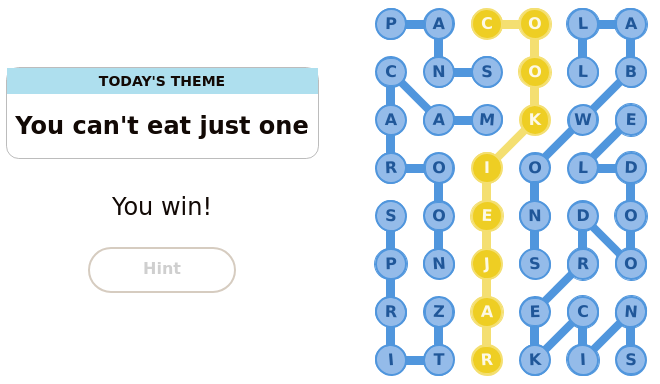
Notice the order of operations: clue first, spangram early, category words last. That sequence — not brute-force tracing — is what makes Strands solvable in ten minutes instead of an hour.
What are the most common beginner mistakes?
- Treating it like a word search. Scanning straight rows and columns finds almost nothing. Words bend — follow adjacency, not lines.
- Ignoring the clue and tracing randomly. The clue is half the game. Read it, brainstorm the category, then hunt.
- Hunting short words only. Long bendy chains feel unnatural to new players, but the spangram and the long theme words are where progress lives.
- Expecting a space in the spangram. It's submitted as one unbroken word — compounds appear fused, like COOKIEJAR or THEODYSSEY.
- Saving hints like they're scarce. Hints are renewable (three non-theme words each) and cost nothing but a stat flag. If you're truly stuck, take one and keep your morning moving.
- Quitting when the grid is "impossible." The board is always complete and self-consistent — every letter belongs to a word. When stuck, re-read the clue and hunt the spangram, don't re-trace the same chains.
Where and when can you play Strands?
- Where: the official puzzle lives at nytimes.com/games/strands and in the NYT Games app for iOS and Android. Playing today's puzzle is free; a subscription is required only for the official puzzle archive (per the NYT Help page, last verified August 2026).
- When: a new puzzle appears at midnight in your local time zone, and your streak counts a solve before the next reset. If you miss a day, your streak resets — one reason solvers keep the game in their morning routine.
- Stats: the game tracks your solve streak and whether you finished without hints — nothing more. There's no leaderboard pressure.
- After you finish: the Strands archive lets you look back at past puzzles' hints and answers, and today's hints are on the homepage when the next puzzle drops.
FAQ
Is NYT Strands free to play?
Yes — the daily Strands puzzle is free on the NYT Games site and app. A subscription is only needed for the official archive of past puzzles.
How many words are in a Strands puzzle?
Usually five to eight theme words plus exactly one spangram. The exact count varies by puzzle, but every letter in the 48-tile grid is used exactly once.
Can words in Strands go diagonally?
Yes. Words can run horizontally, vertically, or diagonally — and they can change direction mid-word. Any path through adjacent letters is valid as long as no tile is reused within the word.
Do you have to find the spangram to finish?
Yes. The spangram is a required word, not a bonus. Most solvers hunt it early because it names the theme and makes the remaining words much easier to spot.
What happens if you guess wrong in Strands?
Nothing. Wrong guesses carry no penalty in Strands — no lost attempts, no streak damage. Free exploration is how you earn hints, so guessing liberally is actively encouraged.
How long does a Strands puzzle take?
Most solvers finish in five to fifteen minutes. Hard themes or unfamiliar categories can stretch longer, and that's normal — difficulty varies a lot day to day.
What should you do after finishing this guide?
Go play today's board — that's the only way this sticks. Read the clue, guess the theme's label, and hunt the spangram before anything else. If you get stuck partway, our daily Strands hints page gives you the next rung of the ladder — theme direction, spangram nudge, or letter reveal — without ever forcing the full answer on you. When you're done, keep the streak alive tomorrow.
Need a nudge for today's puzzle?
Get spoiler-light hints for the current NYT Strands puzzle.
Today's Hints